> ## Documentation Index
> Fetch the complete documentation index at: https://docs.exponent.finance/llms.txt
> Use this file to discover all available pages before exploring further.
# Introduction
> Onchain vault infrastructure for managed rate strategies
***
# Exponent Strategy Vaults
Exponent Strategy Vaults allow managers to run managed strategies across Exponent and DeFi protocols with full onchain transparency.
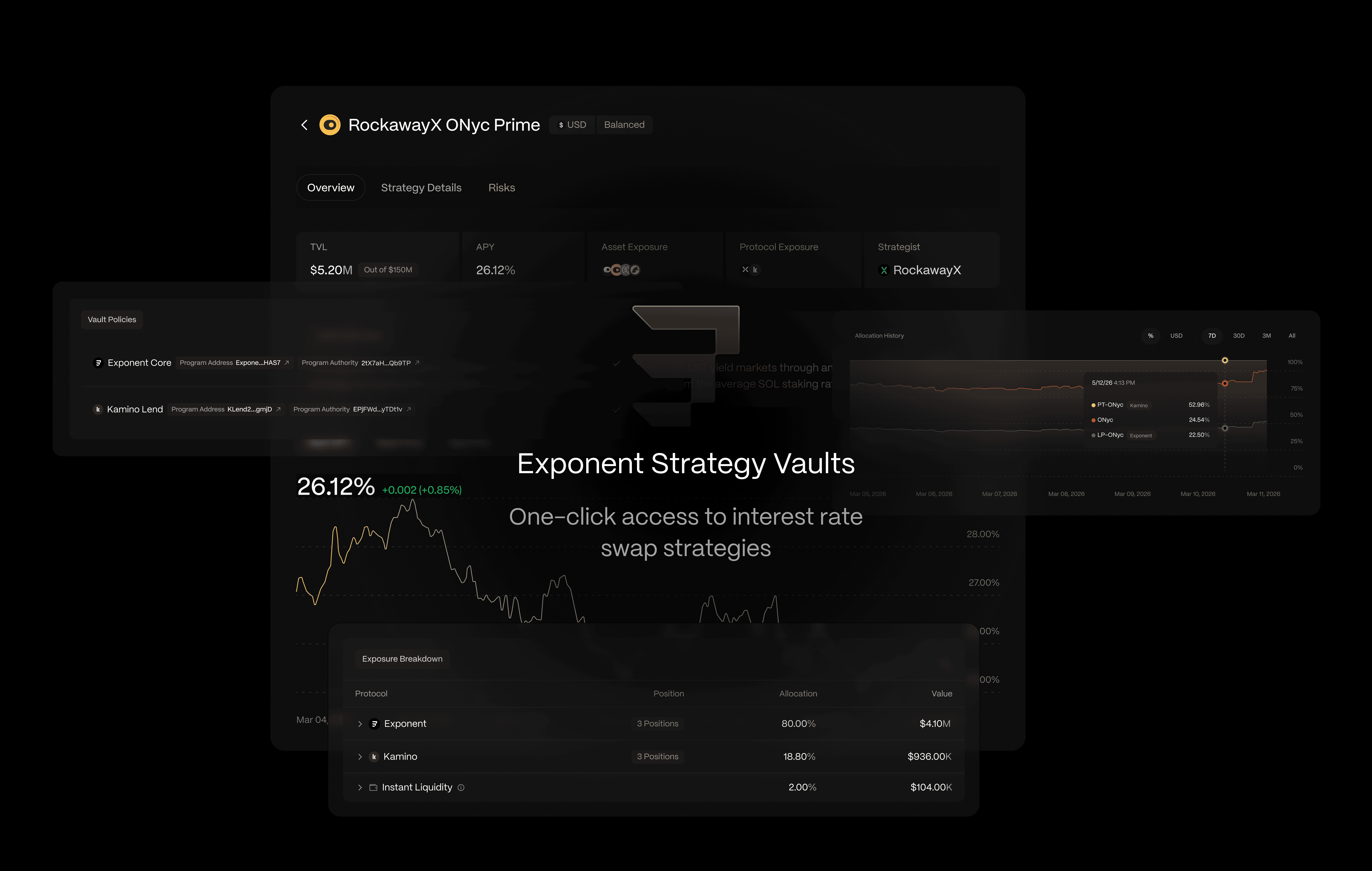 They provide a permissioned execution environment where onchain interactions are governed by policies defined by the manager, visible to vault depositors in real time.
## Strategy Deployment and Policies
Managers control where vault capital can go by setting onchain policies that whitelist specific protocols and interactions. Any transaction that doesn't match an approved policy is rejected automatically.
These policies are publicly readable onchain, so depositors can always see exactly where their capital can be deployed.
### Squads Infrastructure
Exponent Strategy Vaults's policies are built on [Squads](https://squads.so), Solana's smart account standard securing billions in TVL. The Squads Smart Accounts program has been audited by OtterSec, Offside Labs, and formally verified by Certora.
## Role-Based Control
Strategy Vault governance is enforced through distinct roles, each with scoped permissions. Roles can be assigned to individual wallet addresses. A single entity may hold multiple roles, but it is recommended to distribute them across separate addresses.
| Role | Responsibilities |
| ------------- | ------------------------------------------------------------------------------------------------------------------- |
| **Manager** | Full control: initialize the vault, manage all other roles, update strategy positions |
| **Curator** | Add or propose new policies, configure token entries, define which assets the vault accepts and how they are priced |
| **Allocator** | Execute onchain interactions on behalf of the vault within the bounds of approved policies |
| **Sentinel** | Safety operations: can pause or freeze vault operations if conditions require it. Typically maintained by Exponent |
## Deposits and Withdrawals
Depositors send supported tokens into the vault and receive LP tokens proportional to their share of total assets under management. LP tokens are standard SPL tokens, freely transferable and composable.
Withdrawals follow a queued model. Depositors queue a withdrawal request, the vault manager fills it from available liquidity, and the depositor then executes to receive their tokens.
The queued withdrawal model ensures vault managers maintain control over liquidity allocation without forcing immediate liquidation of strategy positions.
## Vault Valuation
Total AUM reflects the combined value of all capital in the vault, both idle and deployed.
* **Idle capital**: tokens held in the vault that have not been allocated to any strategy position.
* **Deployed capital**: tokens allocated to strategy positions. These are priced using the Exponent Prices oracle, which supports direct price feeds and protocol-level position valuations (e.g. Kamino lending positions).
### Vault LP Token Price
Each depositor's share of the vault is represented by LP tokens. The price of one LP token is:
```text theme={null}
lp_token_price = total_aum / total_lp_supply
```
As strategy positions generate yield, total AUM grows while LP supply stays constant, increasing the LP token price for all holders.
### Deposit Cap
Vault managers can set a maximum LP supply to cap total deposits. This is useful when a strategy is optimized for a specific AUM range and may not perform the same at significantly larger scale.
## Vault Fees
Strategy Vaults support three different types of fees, denominated in Vault LP tokens.
All fee rates are stored onchain and readable from the vault account, giving depositors full transparency before they deposit.
The Management Fee is a continuous, annualized percentage charged on assets under management. The fee accrues continuously over time and is collected periodically by the manager.
For example, a 2% management fee on a vault with \$10M in AUM would accrue roughly \$200K per year, distributed proportionally across all depositors.
The Withdrawal Fee is a fee applied when the manager fills a queued withdrawal.
A portion of the LP tokens being withdrawn is transferred to the fee treasury before the remaining LP is burned and the depositor receives the underlying tokens.
```text theme={null}
fee_lp = lp_amount × withdrawal_fee_rate
```
An additional fee for withdrawing directly from vault reserves without waiting for the manager to fill the request. This fee is added on top of the standard withdrawal fee and goes toward the vault share price to compensate vault depositors for idle liquidity.
```text theme={null}
total_fee = withdrawal_fee_rate + instant_withdrawal_fee_rate
```
Instant withdrawals bypass the queued withdrawal flow, allowing depositors to pull from idle reserves immediately at the cost of the higher combined fee.
They provide a permissioned execution environment where onchain interactions are governed by policies defined by the manager, visible to vault depositors in real time.
## Strategy Deployment and Policies
Managers control where vault capital can go by setting onchain policies that whitelist specific protocols and interactions. Any transaction that doesn't match an approved policy is rejected automatically.
These policies are publicly readable onchain, so depositors can always see exactly where their capital can be deployed.
### Squads Infrastructure
Exponent Strategy Vaults's policies are built on [Squads](https://squads.so), Solana's smart account standard securing billions in TVL. The Squads Smart Accounts program has been audited by OtterSec, Offside Labs, and formally verified by Certora.
## Role-Based Control
Strategy Vault governance is enforced through distinct roles, each with scoped permissions. Roles can be assigned to individual wallet addresses. A single entity may hold multiple roles, but it is recommended to distribute them across separate addresses.
| Role | Responsibilities |
| ------------- | ------------------------------------------------------------------------------------------------------------------- |
| **Manager** | Full control: initialize the vault, manage all other roles, update strategy positions |
| **Curator** | Add or propose new policies, configure token entries, define which assets the vault accepts and how they are priced |
| **Allocator** | Execute onchain interactions on behalf of the vault within the bounds of approved policies |
| **Sentinel** | Safety operations: can pause or freeze vault operations if conditions require it. Typically maintained by Exponent |
## Deposits and Withdrawals
Depositors send supported tokens into the vault and receive LP tokens proportional to their share of total assets under management. LP tokens are standard SPL tokens, freely transferable and composable.
Withdrawals follow a queued model. Depositors queue a withdrawal request, the vault manager fills it from available liquidity, and the depositor then executes to receive their tokens.
The queued withdrawal model ensures vault managers maintain control over liquidity allocation without forcing immediate liquidation of strategy positions.
## Vault Valuation
Total AUM reflects the combined value of all capital in the vault, both idle and deployed.
* **Idle capital**: tokens held in the vault that have not been allocated to any strategy position.
* **Deployed capital**: tokens allocated to strategy positions. These are priced using the Exponent Prices oracle, which supports direct price feeds and protocol-level position valuations (e.g. Kamino lending positions).
### Vault LP Token Price
Each depositor's share of the vault is represented by LP tokens. The price of one LP token is:
```text theme={null}
lp_token_price = total_aum / total_lp_supply
```
As strategy positions generate yield, total AUM grows while LP supply stays constant, increasing the LP token price for all holders.
### Deposit Cap
Vault managers can set a maximum LP supply to cap total deposits. This is useful when a strategy is optimized for a specific AUM range and may not perform the same at significantly larger scale.
## Vault Fees
Strategy Vaults support three different types of fees, denominated in Vault LP tokens.
All fee rates are stored onchain and readable from the vault account, giving depositors full transparency before they deposit.
The Management Fee is a continuous, annualized percentage charged on assets under management. The fee accrues continuously over time and is collected periodically by the manager.
For example, a 2% management fee on a vault with \$10M in AUM would accrue roughly \$200K per year, distributed proportionally across all depositors.
The Withdrawal Fee is a fee applied when the manager fills a queued withdrawal.
A portion of the LP tokens being withdrawn is transferred to the fee treasury before the remaining LP is burned and the depositor receives the underlying tokens.
```text theme={null}
fee_lp = lp_amount × withdrawal_fee_rate
```
An additional fee for withdrawing directly from vault reserves without waiting for the manager to fill the request. This fee is added on top of the standard withdrawal fee and goes toward the vault share price to compensate vault depositors for idle liquidity.
```text theme={null}
total_fee = withdrawal_fee_rate + instant_withdrawal_fee_rate
```
Instant withdrawals bypass the queued withdrawal flow, allowing depositors to pull from idle reserves immediately at the cost of the higher combined fee.